
Generator Size Calculator — kW, kVA, Amps, HP
Convert between kW, kVA, amps, and horsepower for any generator from 5 kW to 5 MW. Drag a slider or type an exact value — every calculator updates as you go, and the print sheet captures all seven at their current settings.
Reference figures only. Actual sizing depends on load type, motor starting current, altitude, ambient temperature, and duty cycle. We size the unit to your load — call 877-866-6895.
Standard electrical formulas
| To determine | Single-phase | Three-phase | Direct current |
|---|---|---|---|
| kVA | I × E / 1000 | I × E × 1.732 / 1000 | — |
| Kilowatts | I × E × PF / 1000 | I × E × 1.732 × PF / 1000 | I × E / 1000 |
| Horsepower | I × E × %EFF × PF / 746 | I × E × 1.732 × %EFF × PF / 746 | I × E × %EFF / 746 |
| Kilowatts (when HP is known) | HP × 746 / (1000 × %EFF) | HP × 746 / (1000 × %EFF) | HP × 746 / (1000 × %EFF) |
| Amperes (when HP is known) | HP × 746 / (E × %EFF × PF) | HP × 746 / (1.732 × E × %EFF × PF) | HP × 746 / (E × %EFF) |
| Amperes (when kW is known) | kW × 1000 / (E × PF) | kW × 1000 / (1.732 × E × PF) | kW × 1000 / E |
| Amperes (when kVA is known) | kVA × 1000 / E | kVA × 1000 / (1.732 × E) | — |
I amperes · E volts · PF power factor · %EFF motor efficiency as a decimal. One horsepower equals 746 watts. Three-phase formulas use 1.732, the square root of 3.
Whenever complex electrical calculations are involved, it is always wise to seek the assistance of a certified electrician. The calculators on this page are offered to assist in generating general estimations only. In most instances, there are numerous additional factors that should be accounted for, such as altitude, site conditions, iron losses, and motor efficiencies. If you are still unsure or would like assistance analyzing your current situation, feel free to contact us with your questions.
What each calculator does
Seven conversions, all on this page. Set the phase, voltage, and power factor to match your nameplate, then drag or type.
- kVA to Amps — apparent power to full load current. Power factor does not appear here because kVA already includes it.
- Amps to kW — a clamp meter reading to real power, with apparent power shown alongside.
- kW to Amps — generator rating to the current your conductors and breakers have to carry.
- HP to kW & Amps — motor horsepower to the electrical load a generator has to supply. Leave efficiency at 100% for a straight unit conversion, or select the motor’s efficiency to get the actual input load.
- kW to kVA and kVA to kW — the two directions of the power factor relationship.
- kW to HP — kilowatts to horsepower at 746 watts per HP.
Voltage matters as much as the rating. The same 500 kW set draws roughly 752 amps at 480V and roughly 1,736 amps at 208V — the same machine, a completely different conductor, breaker, and switchgear specification.
Horsepower, kW, and why motors drive generator size
One horsepower is 746 watts, so 100 HP is 74.6 kW as a straight unit conversion. That is the number to use when a spec sheet lists an engine or a load in HP and you need it in kW.
Sizing a generator for a motor is a different question. A motor is not 100% efficient, so the electrical power it draws is higher than the mechanical power it delivers. A 100 HP motor at 93% efficiency pulls about 80.2 kW from the generator, not 74.6 kW. Set the efficiency selector to the motor’s nameplate figure and the calculator accounts for it.
Neither number covers starting current. A motor draws several times its running current for the first seconds of a start, and on motor-heavy sites that inrush — not the running total — is what sets the generator size. Soft starters, VFDs, and staged starting all change the answer. If your load is motor-driven, treat these figures as the starting point for a sizing conversation, not the specification.
Related references
- kVA to kW to amps chart Conversions across a full range of standard generator ratings.
- Power consumption chart Typical running and starting draw for common equipment.
- Diesel fuel consumption chart Gallons per hour by kW and load level.
- Voltages and frequencies by country 50 Hz and 60 Hz service voltages worldwide.
* LEGAL DISCLAIMER: Whenever complex electrical calculations are involved, it is always wise to seek the assistance of a certified electrician. The calculators on this page are offered to assist in generating general estimations only. In most instances, there are numerous additional factors that should be accounted for (such as altitude, site conditions, iron losses, motor efficiencies, etc.). If you are still unsure or would like assistance analyzing your current situation, feel free to contact us with your questions.
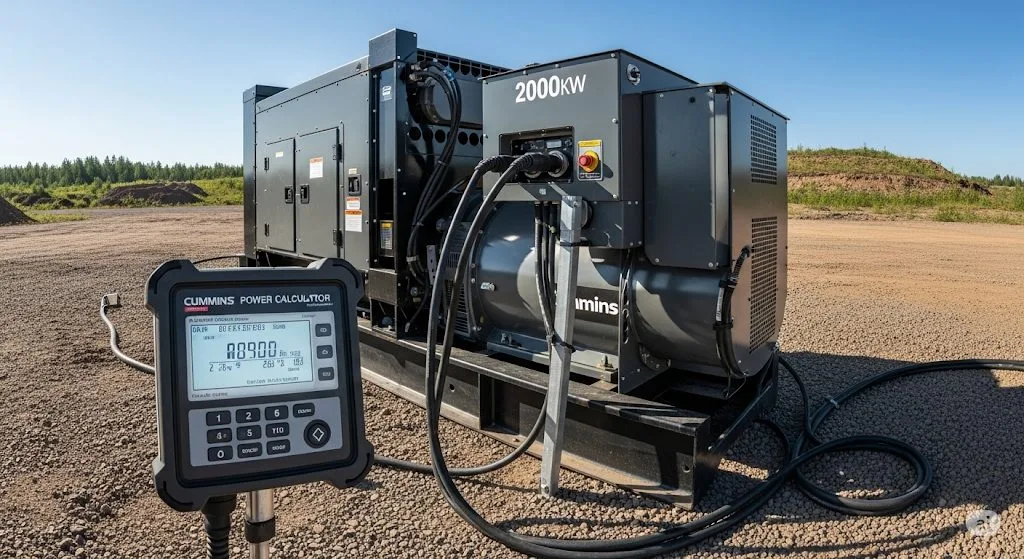
How to Calculate What Size Generator You Need
Before using a power requirement calculator for generators, start by gathering some key data. Answer these questions to ensure accurate calculations:
- What items will the generator power?
Make a complete list of everything that will run on the generator. Missing even a few items could lead to under-sizing, which can result in power shortages. Collaborate with your team to ensure all equipment is accounted for. - What is the starting and running wattage of those items?
Check owner’s manuals for wattage details. If manuals aren’t available, look up the model number online or check the equipment’s identification plate. You can also use a power consumption chart, but keep in mind that these charts only offer estimates. When in doubt, contacting the manufacturer for exact wattage details is the best option. - What is the total power requirement for these items?
Once you have the power requirements, total them up using kilowatts (kW), which is the standard unit for commercial generators. If your equipment lists power usage in amperes, be sure to convert it to watts for consistency.
For more information on determining generator size, read: Sizing a Generator – How to Determine What Size You Need
How to Calculate Your Total Power Requirements
There are several ways to determine your total power needs. Some companies use multiple methods to cross-check their numbers and ensure accuracy. Click here for examples of how wattage usage varies between electrical devices. Here are three common approaches:
1. Measure Peak Usage in Real-Time
Use a clamp-on ammeter to measure the total amperage your facility uses during peak demand. This is important because your generator needs to handle the highest power requirements, not just average usage. Be sure to take measurements across all electrical service sections and add them together.
2. Review Your Monthly Power Bills
Utility bills often include peak demand information. Review past statements and note the highest peak demand over the last year. Then, add 25% extra capacity to account for unexpected surges or future expansions.
3. Calculate Power Based on Facility Size
For businesses like restaurants or hotels, estimating power needs based on square footage can be useful. A general rule of thumb:
- Add 5 watts per square foot, plus 50 kW
- For retail businesses, use 10 watts per square foot instead of 5
After gathering your equipment list and power requirements, consider key variables that can affect your generator sizing calculations.
Important Variables to Consider
Even with an accurate power calculation, external factors can impact generator performance. Keep these considerations in mind:
- Voltage Dips: When motors restart after a power outage, they draw extra current, causing voltage dips. If voltage dips exceed 15%, equipment damage and generator failure may occur. Make sure your generator has enough surge capability.
- Single-Phase vs. Three-Phase Power:
- Single-phase generators work well for small businesses and light applications.
- Three-phase generators are essential for industrial facilities that need continuous power for heavy loads.
- National Electrical Code (NEC) Compliance: If your facility has safety systems, ensure they’re included in your power calculations. NEC standards may also require additional reserve power capacity.
Still have questions?
Generator Source specializes in low-hour, used, new, and surplus generator sets. We have a wide variety of generator sizes and models to fit any project. We are not a broker, we own what we sell.
Call us today (877-866-6895) or click Contact Us to be connected with one of our experienced sales reps.
We have 350+ generators in stock and ready to ship!