

Table of Contents
- Engineering Excellence of the Cummins Platform
- Deep Dive into Core Technical Specifications
- Advanced Control Systems and Digital Telemetry
- The Physics and Utility of Sound Attenuated Enclosures
- Strategic Advantages of Zero-Hour Surplus Equipment
- Industrial Application Case Studies
- Comprehensive Preventative Maintenance Protocol
- Critical Safety and Operational Protocols
Engineering Excellence of the Cummins Platform
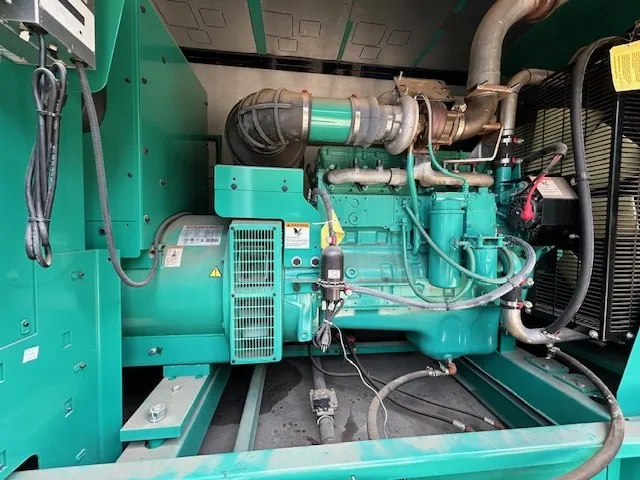
For over a century, Cummins has remained the undisputed vanguard of industrial power generation. The Cummins DQDAA platform, specifically at the 250kW node, represents the culmination of decades of rigorous field testing, advanced metallurgical engineering, and precise computational fluid dynamics in combustion chamber design. Designed for unyielding reliability, the Cummins diesel engines paired with this specific alternator series are engineered to accept 100 percent of their nameplate rating in a single step, ensuring that mission-critical facilities do not experience catastrophic voltage dips during sudden grid failures.
The 250kW output range is widely considered the “sweet spot” for medium-to-large commercial and light industrial applications. It provides enough substantial raw energy to power entire floors of high-demand data processing equipment, vast arrays of manufacturing hardware, or comprehensive life-safety systems in healthcare facilities. Unlike lighter-duty consumer alternatives, the industrial cast-iron block, forged steel crankshaft, and heavy-duty piston assemblies of the Cummins unit are purpose-built to withstand the extreme thermal and mechanical stresses associated with prolonged, high-load emergency operation.
Deep Dive into Core Technical Specifications
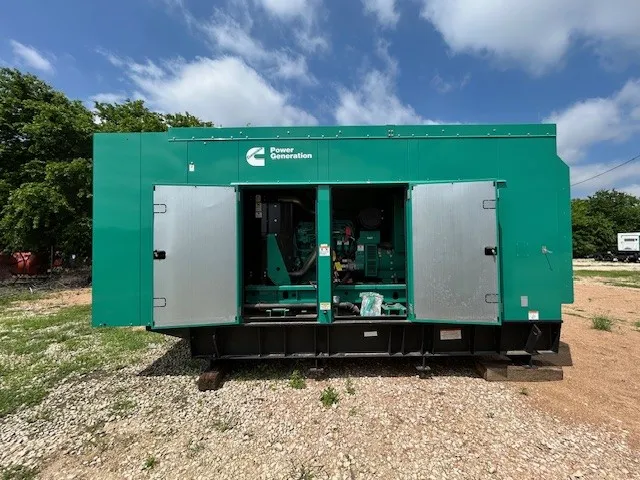
Understanding the nuanced technical capabilities of Unit #093437 is vital for facility managers, electrical engineers, and procurement directors tasked with securing reliable backup power.
250kW Output and Power Delivery Metrics
Operating at a standard power factor of 0.8, this 250kW machine produces approximately 312.5 kVA of apparent power. This robust capacity is generated via a highly efficient diesel combustion engine structurally mated to a premium brushless alternator. The alternator features advanced excitation systems designed to mitigate voltage sag when subjected to the high inrush currents typical of large induction motors, HVAC chillers, and industrial compressors.
277/480V, Three-Phase, 60 Hz Configuration
The electrical architecture of this unit is precisely engineered for industrial compatibility. A 277/480V three-phase system is the gold standard in heavy commercial environments for several mathematically proven reasons. By utilizing a 480V distribution system, the amperage required to deliver 250kW of power is significantly reduced compared to lower voltage systems like 208V.
Applying standard three-phase electrical formulas, the 250kW output at 480V generates approximately 376 Amps of full load current. This lower amperage directly translates to massive capital savings during facility installation, as it permits the use of smaller diameter copper wire and more cost-effective switchgear over long conduit runs. Furthermore, the 277V phase-to-neutral legs are perfectly suited for directly powering massive arrays of commercial fluorescent or LED lighting systems, while the true 480V three-phase power efficiently drives heavy machinery without requiring excessive step-up transformers. Operating at a stable 60 Hz, this unit perfectly matches the North American grid frequency standard, ensuring seamless synchronization and phase-matching when paired with intelligent automatic transfer switches (ATS).
Advanced Control Systems and Digital Telemetry
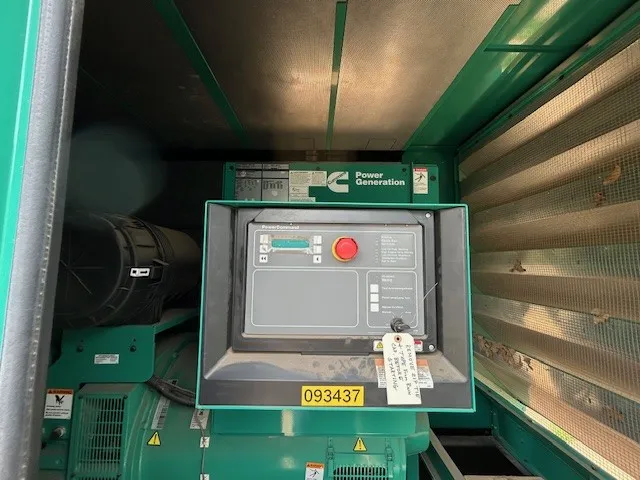
The brain of Unit #093437 is housed within its sophisticated digital control panel. Gone are the days of mechanical governors and analog dials. Modern Cummins platforms utilize proprietary digital controllers designed to monitor thousands of data points per second.
Voltage Regulation and Frequency Control
The digital controller maintains an incredibly tight voltage and frequency regulation tolerance. Even when hit with substantial non-linear loads—such as Variable Frequency Drives (VFDs) or Uninterruptible Power Supply (UPS) rectifiers—the control system instantly adjusts the fuel injection rate and alternator excitation field to stabilize the sine wave. This produces clean, harmonic-free power crucial for sensitive IT infrastructure and delicate medical imaging equipment.
Telemetry, Diagnostics, and Alarm Logging
For maintenance personnel, the digital interface provides comprehensive, real-time telemetry. Operators can instantaneously review precise metrics including oil pressure, coolant temperature, battery float voltage, engine RPM, and total runtime hours. The system is fully compliant with NFPA 110 standards, providing localized and remote annunciation of any pre-alarms or critical fault conditions. If the unit detects a catastrophic anomaly—such as a sudden loss of oil pressure or extreme thermal runaway—the controller will automatically initiate a protective shutdown sequence, saving the engine from irreversible destruction.
The Physics and Utility of Sound Attenuated Enclosures
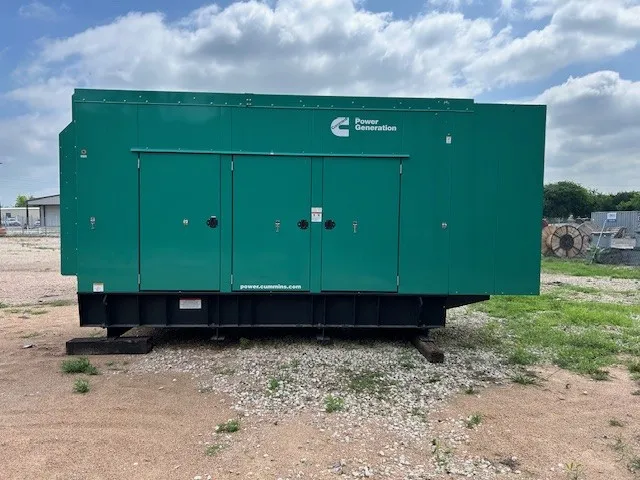
An unhoused diesel engine operating at an 1800 RPM synchronous speed moves massive volumes of air and exhaust gases, generating a severe acoustic footprint that can easily exceed 100 to 110 dB(A). Unit #093437 features a highly engineered, factory-installed sound attenuated enclosure designed to aggressively combat noise pollution.
Acoustic Engineering Principles
Sound attenuation is not merely about wrapping a generator in metal; it is a complex exercise in acoustic physics and thermal management. The interior of the housing is lined with high-density acoustic foam constructed to absorb specific mid-to-high frequency sound waves produced by mechanical clatter and combustion.
Furthermore, the enclosure features intricate, baffled air-intake and discharge louvers. Because sound waves travel in straight lines, these internal baffles force the noise to navigate a labyrinthine path, effectively trapping the acoustic energy and converting it into negligible amounts of heat before it can exit the enclosure. The unit also features an internally mounted critical-grade exhaust silencer. Together, these systems drastically reduce the operational decibel level, ensuring compliance with strict municipal noise ordinances and making this unit perfectly suitable for deployment adjacent to hospitals, residential neighborhoods, and corporate campuses.
Weather Resistance and Durability
Beyond acoustics, the enclosure serves as a virtually impenetrable fortress against environmental degradation. The heavy-gauge steel or aluminum construction is treated with an industrial-grade powder coating, designed to withstand intense UV radiation, driving rain, and corrosive coastal air without rusting or compromising structural integrity. Lockable access doors protect the internal components from unauthorized tampering or vandalism, ensuring the unit is always secure and ready to perform.
Strategic Advantages of Zero-Hour Surplus Equipment
Unit #093437 is categorized as a 2020 model year unit with exactly 0 logged operational hours. In the industrial power sector, this is referred to as “New Old Stock” or surplus equipment. The strategic procurement of zero-hour surplus hardware presents massive logistical and financial advantages over attempting to source fresh equipment directly from the factory line.
Immediate Deployment Capabilities
The most glaring advantage is the absolute circumvention of OEM lead times. Currently, ordering a new 250kW generator from a major manufacturer can subject a facility to waiting periods stretching from 40 to over 60 weeks due to ongoing global supply chain constraints regarding microchips and heavy castings. This unit, however, is on the ground, visually inspected, and ready for immediate freight dispatch.
Financial Efficiency and Capital Allocation
By acquiring a zero-hour 2020 unit, organizations capture the exact same pristine, un-run mechanical condition of a brand-new asset without paying the premium associated with current-year factory pricing. This enables procurement teams to maximize their capital expenditure (CapEx) budgets, potentially allowing for the simultaneous purchase of higher-tier automatic transfer switches, comprehensive load bank testing hardware, or extended maintenance contracts with the savings achieved.
Industrial Application Case Studies
To fully comprehend the utility of a 250kW Cummins generator, one must look at how it seamlessly integrates into various high-stakes commercial environments.
Scenario A: Mid-Sized Manufacturing and Precision Machining
In a CNC manufacturing facility, an unexpected power outage does more than just stop production; it ruins materials. If power drops while a precision multi-axis lathe is carving an expensive titanium aerospace component, the tool bit crashes, ruining both the bit and the material. A 250kW generator paired with a fast-acting ATS will sense the grid failure and restore clean, three-phase 480V power in under ten seconds, allowing operators to safely pause processes, clear machines, or continue vital production cycles. The robust alternator on the Cummins DQDAA is specifically designed to handle the heavy inrush currents required to restart these massive induction motors simultaneously.
Scenario B: Regional Healthcare and Outpatient Surgical Centers
Healthcare facilities are bound by strict NFPA 99 and NEC Article 517 regulations requiring emergency power systems to come online within 10 seconds of a primary power failure. A 250kW machine is ideal for sustaining essential life-safety branches. This includes maintaining power to operating room lighting, critical care telemetry stations, bulk oxygen delivery pumps, and emergency egress lighting. The digital voltage regulation of this unit ensures that highly sensitive MRI and CT imaging equipment is not damaged by electrical transients during the transfer of power.
Scenario C: Edge Data Centers and Telecommunications Hubs
As the world becomes increasingly reliant on low-latency cloud connectivity, localized edge data centers require absolute power redundancy. A 250kW Cummins unit provides ample energy to support server rack PDU loads, but more importantly, it provides the immense power required to keep the facility’s HVAC computer room air conditioning (CRAC) units running. Without immediate cooling, a densely packed server room will reach catastrophic thermal failure temperatures in a matter of minutes. The reliability of the Cummins diesel platform ensures uninterrupted uptime, preserving the data center’s crucial Service Level Agreements (SLAs).
Comprehensive Preventative Maintenance Protocol
The operational lifespan of a heavy-duty diesel generator is directly proportional to the rigor of its maintenance schedule. Treating this 250kW asset with a meticulous preventative maintenance program will ensure multi-decade reliability.
Daily and Weekly Inspections
Facility technicians should perform a visual walkaround weekly. This includes checking for any minute coolant, oil, or diesel fuel weeping beneath the skid. The block heater must be physically touched to ensure it is warm; a cold engine block will dramatically increase start times and subject internal components to excessive friction. The control panel must be verified to be in the “Auto” position with no active alarms.
Monthly Systems Verifications
Battery health is the most critical point of failure in generator systems. Monthly checks must include verifying the battery charger output, checking the specific gravity of the battery electrolyte (if using flooded lead-acid), and cleaning terminal posts to prevent high-resistance sulfation buildup. Belt tensions on the engine driven fan and alternator must be assessed for proper deflection.
Annual Deep Servicing
Once a year, the unit requires a full fluid and filter swap. Oil must be drained and replaced with high-quality diesel-grade lubricants, and all primary and secondary fuel filters must be changed. Coolant chemistry should be analyzed with test strips to verify freeze point protection and to ensure the supplemental coolant additives (SCA) are at proper levels to prevent cylinder liner cavitation.
The Critical Importance of Load Bank Testing
Because this unit features 0 hours, it is vital to institute an annual load bank test. Diesel engines must run hot to operate properly. If a 250kW generator is only ever tested without a load, the internal combustion temperatures never rise high enough to fully expand the piston rings. This leads to “wet stacking”—a condition where unburned diesel fuel and soot blow past the rings and accumulate in the exhaust manifold, creating a severe fire hazard and degrading engine performance. A resistive load bank test physically forces the generator to run at 80% to 100% capacity for several hours, burning off these carbon deposits and mathematically proving the generator can produce its full 250kW nameplate rating.
Critical Safety and Operational Protocols
Interacting with a 250kW generator operating at 480V requires strict adherence to comprehensive safety frameworks to prevent fatal electrical or mechanical accidents.
Electrical Hazards and Arc Flash Safety
At 480 Volts and nearly 400 Amps of potential current, the risk of an arc flash is severe. Maintenance personnel must never open the main alternator terminal box or breaker panel while the unit is running. Strict Lockout/Tagout (LOTO) procedures must be enforced, completely isolating the generator from the grid and physically removing the starter battery cables before any internal mechanical or electrical work is performed. Technicians must wear appropriate NFPA 70E compliant Personal Protective Equipment (PPE) when verifying voltage absence.
Proper Exhaust and Carbon Monoxide Management
Even outdoors, the sheer volume of exhaust produced by a 250kW engine is lethal. The generator must be installed with strict adherence to manufacturer clearances, ensuring the exhaust discharge is not directed toward facility air intake louvers, open windows, or pedestrian walkways. Proper overhead clearance is required to prevent heat accumulation and fire hazards.
Fuel Handling and Environmental Compliance
Diesel fuel is a highly regulated substance. Ensure the base fuel tank is equipped with proper secondary containment ruptures basins to prevent ground contamination in the event of a tank breach. Fuel should be polished and treated with biocides annually to prevent microbial growth and water accumulation, which will clog fuel injectors and stall the engine during an emergency.
By understanding the intricate technical specifications, respecting the rigorous safety parameters, and executing precise maintenance, facility managers can rely on this 250kW Cummins generator to protect their assets, operations, and personnel against all power instability threats.
Call Us: 877-866-6895
View Unit: https://generatorsource.com/250kw-cummins-unit-093437/
Email Sales: [email protected]