
Generators supply auxiliary electric power during outages of power supply from the local electricity distribution company. This is done by using input mechanical energy to initiate combustion of fuel and converting the energy released to electrical energy. Please read this article for more information on how a generator creates electricity. If no fuel is available to the generator during power outages then the purpose of the generator is lost. Hence it is essential to store fuel so that such an eventuality does not arise. The fuel is stored in specially designed fuel tanks. Several factors need to be considered while selecting and installing the appropriate generator fuel tank.
Determining the Fuel Tank Capacity
You will first need to determine how much fuel you need to store as this will determine the capacity of your fuel tank. Calculate the minimum storage capacity by first estimating the following three parameters.
Emergency Stock
How much fuel would you require to allow for delays in supplies or excessive consumption needs?
Lead-Time for Supply
What is the lead-time required to purchase fuel from the vendor to the generator site?
Lead-Time Stock
How much fuel would you require to operate your generator during the lead-time?
Based on the above three parameters, the minimum storage requirement is determined as –
- Minimum storage capacity = Emergency Stock + Lead-time Stock
What Level of Fuel Storage Capacity Is Best Suited for You?
In the case of power outages that are infrequent or of short durations, a smaller storage tank would suffice for your fuel requirements. However, you will need to purchase fuel more frequently in smaller lots to refill your tank. While you incur low initial investments (capital costs) in setting up your storage tank and low maintenance costs, the per unit delivery cost of fuel would be higher.
Large storage tanks are required when the generator is used to support large commercial establishments or where power outages are frequent and last for long periods of time. In this case, you can purchase the fuel less frequently and in larger lots. However, you will incur higher initial expenditure (capital costs) in setting up your storage tank. The maintenance costs will also be high in the long run. On the other hand, the per unit delivery cost of fuel is reduced since you can order large quantities of fuel to be delivered in one go. However, you will also need to account for the hidden costs arising from the hazards of storing a larger quantity of fuel.
Before finalizing the storage capacity, it is essential to finalize the contract for the supply of fuel with the vendor. The vendor’s capacity to supply the required quantity at the required frequency should be assessed and penalties for default should be incorporated in the contract.
Types of Fuel Tanks
Generator fuel tanks are usually of three types –
Sub Base Tanks
If you need to store less than 1,000 gallons of fuel, you would need sub base tanks. As the name suggests, sub base tanks are designed to fit above the ground but below the base of the generator set.
Sub base tanks are rectangular in cross section and are double walled tanks. This helps to prevent spillage of fuel in case of leakage. Both tanks should be constructed using heavy gauge welded steel. Several piping and fittings are attached to the primary tank, the important ones being fuel supply and return, air vent, emergency pressure relief valve, and high and low-level fuel alarms. The tank fill system has to be designed such that there is no spillage during filling and the inlet valve automatically closes when the tank is 95% full. After installation, the primary tank is tested at 5 psig, and the secondary tank is tested at 3 psig.
Underground Storage Tanks
If you need to store more than 1,000 gallons of fuel, you can opt for underground storage tanks or above ground storage tanks. Underground storage tanks are more costly to install but have a longer life because they are shielded from the environment. Underground storage tanks can be constructed from fiberglass-reinforced plastic. Such tanks are usually ribbed so as to provide structural strength. Alternately, underground storage tanks can be fabricated from steel but with appropriate cathodic protection against corrosion from ground water. Likewise, piping from the underground storage tank to the generator can be of fiberglass-reinforced plastic or cathodically protected steel.
Leakages and spillages in underground storage tank systems can be costly and difficult to rectify. Such systems must be fitted with overfill and spill prevention equipment and procedures. In the worst-case scenario, the installation of underground storage tanks should be such that spills or leakages of fuel are contained to a limited area. Hence, the underground area is surrounded by concrete floor and walls. After the underground storage tanks are installed within this area, the external region is packed with sand and gravel.
Above Ground Storage Tanks
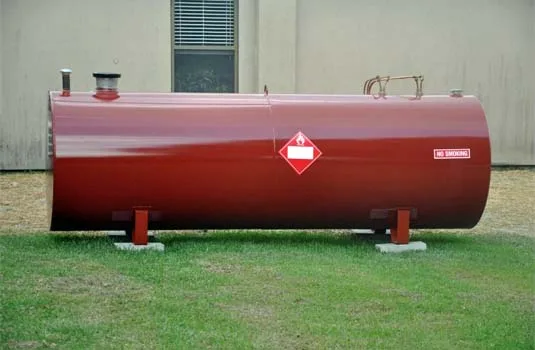
As the name suggests these tanks are installed above the ground. While these are similar in construction to underground storage tanks, there is a lot of difference in the installation procedures of the two kinds of fuel storage tanks. This is due to the different factors that need to be considered for minimizing the hazards. Above ground storage tanks pose a fire hazard with the risk of fire spreading to other facilities in the vicinity. Therefore, these tanks have to be installed at a minimum specified distance from other facilities. In order to contain spills and leakages, dikes have to be built around above ground storage tanks. The free volume enclosed by the dikes should generally be 110% of the volume of the tanks. Above ground storage tanks also need to be shielded from weather conditions by suitable protective structures.
Approvals and Codes
Generator fuel tanks and the accompanying piping systems need pre-approval before installation. This is a requirement not only for industrial undertakings but also for fuel tanks used for domestic or commercial use. Only tanks of very small capacities may be exempt from approvals. You are required to submit a proposal to the State Fire Marshall. The details that have to be furnished include manufacturing drawings, product data sheets for all components purchased additionally, proposed controls and wiring diagram, proposed piping layout, and manufacturers’ installation instructions.
Several codes need to be followed during the manufacturing and installation of generator fuel tanks. The primary code in the US is the National Fire Protection Association Codes and Standards (NFPA). The relevant sections of the NFPA for generator fuel tanks are NFPA30 and NFPA37. The Code of Federal Regulations Title 40 Section 112 deals with spill prevention from generator fuel tanks.
Understanding Base Tank Options
Base tanks are built directly into the skid of the generator, creating a compact, integrated solution. These tanks:
- Provide runtime ranging from a few hours to several days, depending on size.
- Simplify transport and installation by reducing the need for external tanks.
- Include features like fuel gauges, leak detection, and venting for safety.
The most common designs include single-wall tanks and double-wall (UL 142 or UL 2085) tanks, with the latter offering enhanced safety and compliance.
Double-Wall and UL 2085 Tanks
One of the recurring points from our yard review was the importance of UL 2085 double-wall tanks. These tanks are designed with both an inner and outer wall, providing extra protection against leaks and fire exposure.
- UL 142 Tanks: Standard double-wall protection, widely accepted in industrial settings.
- UL 2085 Tanks: Fire-rated and impact-resistant, often required for hospitals, schools, and urban projects.
For customers, the distinction matters because local ordinances, insurance providers, and bid specifications may require UL 2085 compliance. Choosing the wrong tank can mean failing inspection or facing costly retrofits.
The Risks of Neglecting Fuel Tanks
Fuel systems are one of the most common causes of generator failures, and many of those issues originate in the tank itself. Common risks include:
- Contamination: Water intrusion, microbial growth, and sediment buildup lead to clogged filters and engine stalls.
- Leaks: Single-wall tanks without secondary containment create environmental and safety hazards.
- Aging Materials: Corrosion or damaged welds reduce structural integrity.
- Regulatory Violations: Non-compliant tanks can halt projects or trigger fines.
During our yard walk, we flagged several older tanks for inspection or scrapping. Even if the generator is mechanically sound, an unreliable tank makes the system unfit for service.
Regional Considerations: Colorado, Florida, and Texas
Fuel planning looks different depending on where a generator operates.
- Colorado: Cold weather creates risks of fuel gelling, insulated tanks and heaters may be necessary.
- Florida: Hurricanes and flooding create risks of water contamination, double-wall tanks with secure venting are a must.
- Texas: Extended heat waves and long-duration outages put greater emphasis on tank capacity and refueling contracts.
These regional factors make fuel tank decisions just as critical as generator selection itself.
When Fuel Becomes the Weak Link
In one recent inspection, our service team found a commercial property where the generator was in excellent condition, but the tank had not been filled or inspected in nearly three years. The fuel inside had degraded, creating sludge that would have clogged the system during the next outage.
The solution required draining, cleaning, and refilling, but it was a reminder that fuel management is not optional. A generator without clean, available fuel is just an idle piece of equipment.
When To Retrofit or Replace Tanks
Our operations team regularly advises customers on whether to retrofit existing tanks or replace them entirely. Factors that drive this decision include:
- Tank Age: Older single-wall tanks often don’t meet modern standards.
- Condition: Corrosion, leaks, or weak welds warrant replacement.
- Compliance Requirements: If a facility needs UL 2085 certification, upgrading may be mandatory.
- Runtime Needs: Larger loads and longer outage expectations sometimes justify external or larger tanks.
By addressing tank issues early, customers avoid emergencies and compliance delays.