
EGSA certification is a credential held by an individual generator technician. The Electrical Generating Systems Association (EGSA) issues it after the technician passes an exam on the installation, maintenance, service, and repair of onsite power generation systems. Because the credential belongs to the person, it stays with that technician from one employer to the next and from state to state, according to EGSA’s certification FAQ.
Quick answers
- EGSA offers two generator technician certifications, Apprentice and Journeyman.
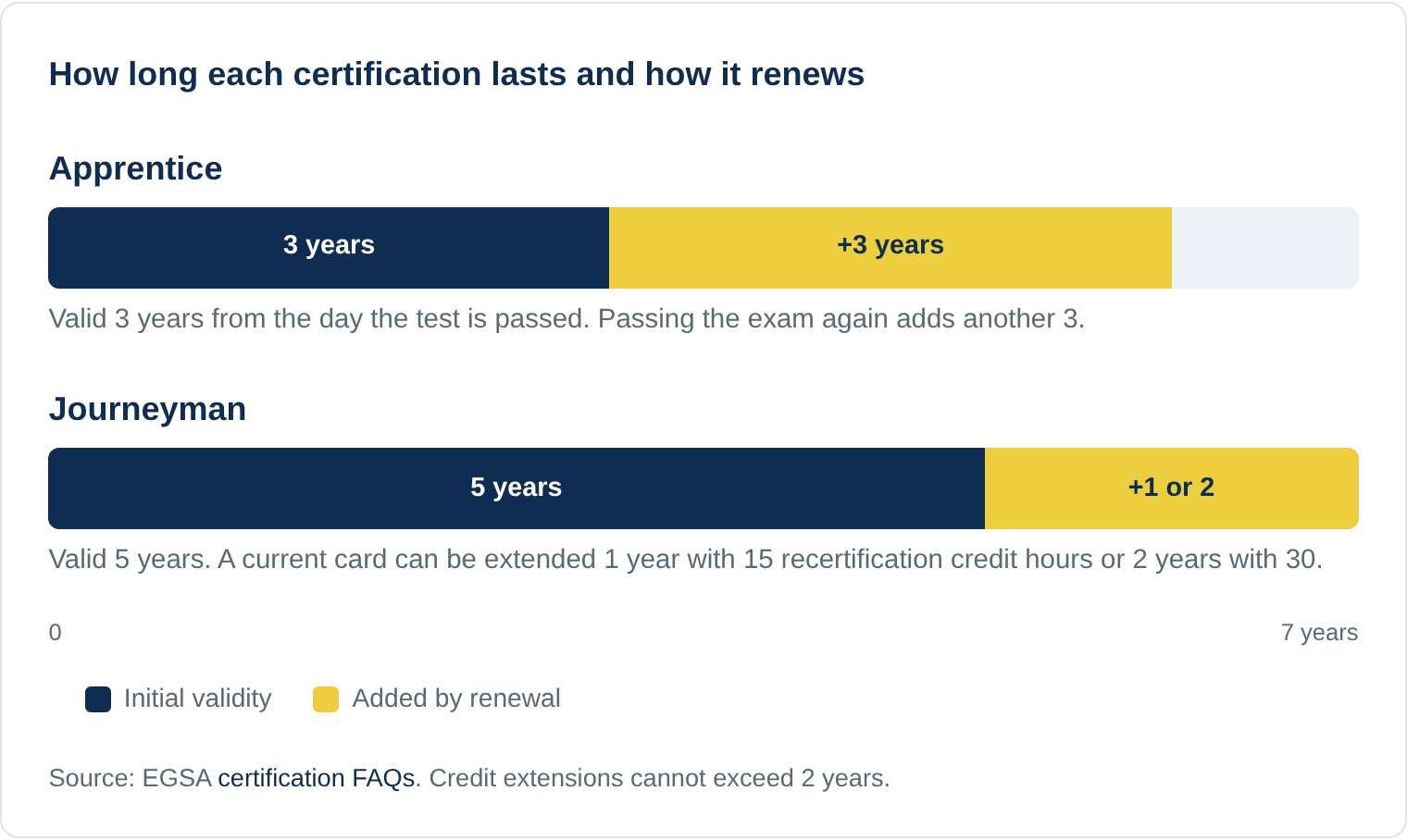
- Apprentice covers more than 40 knowledge areas and is valid for three years. Journeyman covers 61 areas and is valid for five years.
- A certified technician carries a certificate and a wallet card that show the certification level and its dates.
- Certification measures what a technician knows. Experience with your particular generator is a separate question worth asking.
What is EGSA certification for generator technicians?
EGSA is the industry association for onsite power. It describes its Generator Technician Certification as a recognized industry standard for technical knowledge in installing, maintaining, servicing, and repairing generator systems. The exams draw on mechanical systems, electrical systems, controls, safety practices, and the way generator set components interact, as laid out on EGSA’s certification program page.
The credential attaches to a person, so the useful question for a service provider is which certified technician will work on your equipment. A company can employ certified technicians and still send a different person to your site.
What is the difference between EGSA Apprentice and Journeyman certification?
EGSA designed the two levels for different career stages. Apprentice is for technical college students, recent graduates, military personnel moving into civilian careers, and technicians in their first two years in the field. Journeyman requires at least three years of experience as a generator equipment technician, and its exam covers more ground.
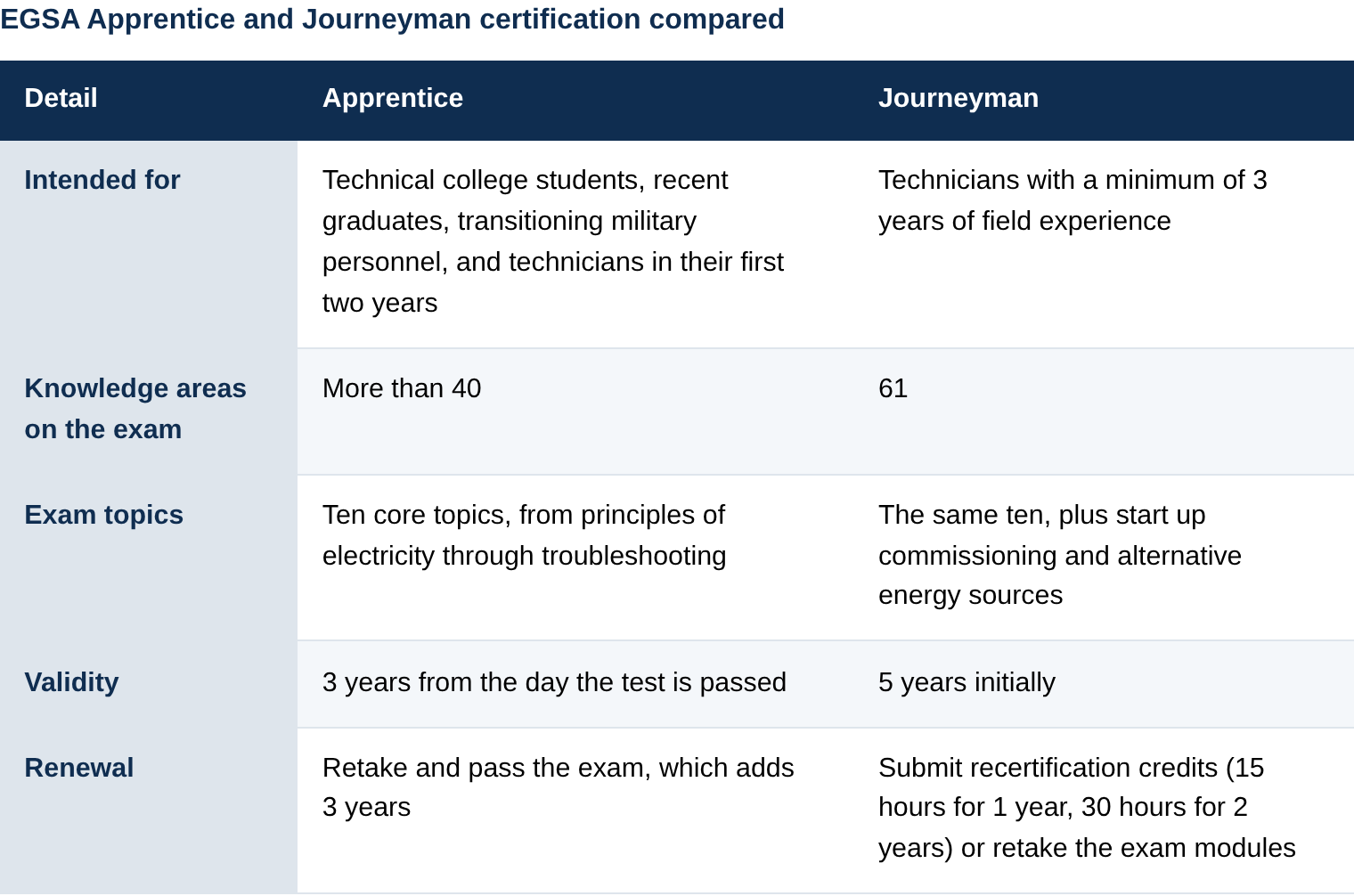
Source: EGSA certification program and FAQ pages.
The Journeyman exam is split into four one-hour modules taken within a 120-day testing period, and a technician who fails a module can retake it during that period, according to EGSA’s FAQ. Recertification credits apply to Journeyman technicians only, and only while the certification is current. A Journeyman card that has lapsed means retaking the exam.
What do the EGSA exams cover?
The Apprentice exam covers ten topics. The Journeyman exam covers the same ten and adds two more. The table pairs most of them with a guide we’ve published on the same subject.
EGSA exam topics and related guides from Generator Source
| EGSA exam topic | Exam level | Related guide |
|---|---|---|
| Generators and alternators | Both | The technician’s guide to excitation troubleshooting |
| Voltage regulators | Both | Voltage regulation testing and maintenance |
| Governors | Both | Diesel engine generator governors |
| Engine instrumentation and controls | Both | Generator control panels |
| Automatic transfer switches | Both | Automatic transfer switch selection for diesel generators |
| Multiple generator switchgear and controls | Both | Automatic transfer switches versus switchgear |
| System communications | Both | Remote monitoring for generators |
| Troubleshooting system problems | Both | The most common generator service issues we see in the field |
| Start up commissioning | Journeyman only | The industrial generator installation roadmap |
Exam topics as listed in EGSA’s certification FAQ.
How do you verify a technician’s EGSA certification?
EGSA’s FAQ says every technician who passes receives a certificate and a wallet card. The card names the certification type, Apprentice or Journeyman, and lists its effective and expiration dates. Technicians may also wear the EGSA uniform patch. The card is the item that carries the dates.
- Ask which technician will be assigned to your equipment.
- Ask to see the card, and read the certification level and the expiration date.
- Check that the date hasn’t passed. A lapsed Journeyman card can’t be extended with credits, so that technician has to retest.
- For independent confirmation, contact Ferris State University using the details on EGSA’s certification FAQ.
What should you ask a commercial generator service provider?
A search for “commercial generator service near me” turns up plenty of providers, and location only narrows the list. Certification adds one more check. The questions below cover the rest, and sending the same set to every provider you’re considering puts the answers side by side.
Questions to ask a generator service provider
| Question | What the answer tells you |
|---|---|
| Which technician will work on my equipment, and what are the certification level and expiration date? | The credential belongs to an individual, so it only helps when it matches the person who comes to your site. |
| Has that technician worked on my generator’s manufacturer and controller? | The exam topics cover onsite power systems in general. Familiarity with a particular brand or control platform comes from field time. |
| How will findings be documented, and who approves added work? | A written record of findings gives the next visit a starting point, and an approval step keeps scope changes visible. |
| Which inspections and tests does the written scope include? | A line-by-line scope makes quotes comparable. Our preventative maintenance plans are built around a 31-point inspection. |
| Who follows up if the problem returns? | A named contact for completed work saves time on a repeat call. |
| How are emergency calls handled, and which branch is closest? | Response arrangements differ between providers. Ours are described on our emergency generator service and locations pages. |
You can put the same questions to our service team. We have branches in Brighton, Jacksonville, Pensacola, and Austin.
EGSA certification is a knowledge credential. Electrical licensing and permit requirements are set locally, so confirm those separately for any installation project. Our guides to the industrial generator installation roadmap and to generator installation engineering and permitting cover the project side.
Where does technician certification show up in real service work?
EGSA’s exam topics include automatic transfer switches and troubleshooting, and those line up with the faults our technicians run into most. In our experience, a weak battery is the most common reason a commercial generator fails to start, and the transfer switch comes second. Our post on what our techs see go wrong with commercial building generators describes the pattern, including a landfill unit where an earlier service company blamed the engine and a transfer test showed the phase rotation was wrong.
Load bank testing has a credential of its own. EGSA’s Load Bank Certification is a 2 1/2-day program that ends with a performance and written exam. If your service scope includes a load bank test, ask who will run it and what training that person holds. Our load bank testing page explains what the test involves.
Training continues after the exam. Our Jacksonville branch recently held a hands-on session covering service-rated and non-service-rated transfer switches and NEMA enclosure ratings, with live demonstrations of open and closed transition. It’s described in our Jacksonville ATS training post.
How do technicians earn and keep EGSA certification?
A technician starts by requesting an exam from EGSA. The test is scheduled at a site near the technician’s home or workplace and supervised by a proctor. Passing earns a certificate and a wallet card, along with an insignia for the uniform.
EGSA lists several ways to prepare for the exams:
- Study guides, which are practice booklets that list the knowledge areas and include practice questions
- The EGSA Certification Bootcamp, a four-hour instructor-led review offered in person and online
- EGSA’s Onsite Power Generation reference book, which EGSA recommends alongside the study guide
- An approved formula sheet that technicians can use during the exam
Employers can track expiration dates and plan renewals ahead of time. Journeyman recertification credits must be earned in the final one or two years before the card expires and submitted within 30 days after the expiration date, and a missed window means retaking the exam, per EGSA’s FAQ.
Technicians interested in a generator service career can start on our careers page.
EGSA-certified generator service from Generator Source
Our service technicians hold EGSA certification. We service diesel and natural gas generators from 20kW to 4MW+ at commercial and industrial sites, working out of branches in Brighton, Jacksonville, Pensacola, and Austin.
The work includes preventative maintenance built around a 31-point inspection, load bank testing, emergency repair around the clock, and fuel delivery. Our locations page lists every branch.
Colorado customers can also review our Denver metro and northern Colorado service area pages. Each branch has its own page as well: Brighton, Jacksonville, Pensacola, and Austin.
Frequently asked questions
What is EGSA certification? EGSA certification is an industry credential for individual generator technicians, issued through the Electrical Generating Systems Association. It validates a technician’s knowledge of mechanical systems, electrical systems, controls, safety practices, and how generator set components interact.
What is the difference between EGSA Apprentice and Journeyman certification? Apprentice is for students, recent graduates, transitioning military personnel, and technicians in their first two years. It covers more than 40 knowledge areas and is valid for three years. Journeyman requires at least three years of field experience, covers 61 areas, and is valid for five years.
How long does EGSA certification last? An Apprentice certification lasts three years from the day the test is passed, and renewal means retaking and passing the exam. A Journeyman certification lasts five years. A currently certified Journeyman technician can extend it by one year with 15 recertification credit hours or by two years with 30, and no extension can exceed two years.
How can I verify that a generator technician is EGSA certified? Ask to see the technician’s certificate or wallet card, which shows the certification type and the effective and expiration dates. EGSA’s FAQ also lists Ferris State University as a contact for confirming a technician’s status.
Is EGSA certification required to service a commercial generator? EGSA presents the certification as an industry standard that employers use to verify technician competency, and EGSA’s program pages do not describe it as a legal requirement. Contracts and facility policies may ask for it, so confirm what applies at your site.
Does EGSA certify generators or service companies? No. EGSA certification applies to individual technicians. Equipment carries its own approvals, such as EPA emissions tier ratings, which our EPA tier rating decoder explains.
Are Generator Source technicians EGSA certified? Yes. Our service technicians hold EGSA certification, and we service diesel and natural gas generators from 20kW to 4MW+ out of branches in Brighton, Jacksonville, Pensacola, and Austin.
Request service online or call 877-866-6895. Need urgent help? See our emergency generator service page or find your nearest branch.