There is no single checklist that makes a standby generator compliant. What your generator has to do, how often it has to be tested, and which standards apply all depend on what the generator protects, what industry you are in, and the codes your local Authority Having Jurisdiction enforces. Two identical 2000kW units can carry very different obligations depending on where they are installed and what they power. Before anything else, the first step is always to verify the specific requirements for your facility and your area.
But underneath every one of those programs sits the same requirement: at some point, you have to prove the generator will actually do its job when the power fails. One of the most revealing ways to prove it is a block load test. We recently ran one on a 2025 Rehlko 2000REOZMD at our Brighton, Colorado facility, a new, enclosed 2000kW standby diesel unit with about an hour on the clock. Here is what that looks like.
What a Block Load Test Is
Standard load bank testing applies load in stages, typically stepping from 50% to 75% of capacity, giving the engine time to ramp up and stabilize at each interval. A block load test works differently. The load is applied all at once, held, then dropped and reapplied. No ramp. No staging. The generator either handles the hit cleanly or it does not.
The specific capability being tested is called load acceptance, sometimes referred to as transient response: the unit’s ability to take a sudden, full-demand load without significant voltage sag, frequency deviation, or shutdown. A generator can pass a stepped load bank test in good form and still stumble under a block load event if the governor response is slow or the fuel system cannot keep up with a sudden inrush.
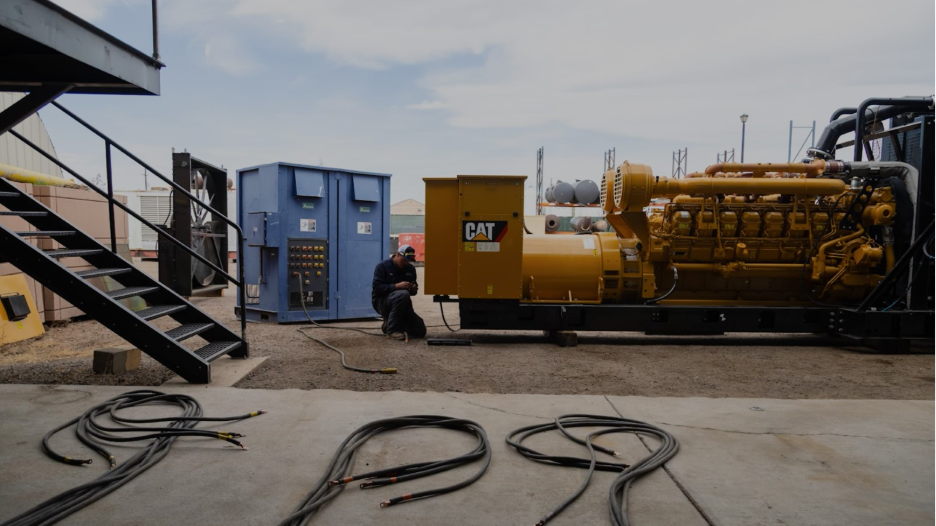
A portable load bank is cabled directly to the generator’s output for a controlled, measurable test.
The unit in the video is a good example of what is under test. Unit 091959 is powered by a Mitsubishi S16R-Y2PTAW2-1 engine, runs three-phase 277/480V at 3,007A, and carries roughly one hour of runtime, so this was its first real stress event. Because Brighton sits at roughly 5,000 feet, the unit is tested to about 80% of nameplate to account for altitude derating. As Generator Source technician Cole explains it, a 2000kW unit rated for 3,007 amps gets load banked to 80% here because of the altitude. The test puts that full available load on the generator at once, drops it, and puts it back on, confirming the unit will perform exactly as it needs to when the ATS transfers during a real outage.
Why and Where It Matters
When the transfer switch fires during an outage, the generator does not get to ease in. The entire demand lands on it at once, in a single step, with no ramp. NFPA 110, the national standard for emergency and standby power systems, builds its most critical requirement around exactly that moment: the most critical systems have to start and pick up their full emergency load within 10 seconds of losing utility power.
NFPA 110 sets the testing baseline most facilities work from. It requires you to exercise the generator monthly, run a longer load bank test annually if those monthly runs do not put enough load on the engine, and complete a full-capacity test every three years, all documented. A standard load bank test, where load is added gradually in stages, proves the engine is healthy and can hold load over time. What it does not prove is how the unit behaves when the whole load hits at once, which is the specific behavior that 10-second transfer requirement assumes your generator is capable of. A block load test proves it directly.
That baseline is only the starting point, though. The standards a given facility actually answers to depend on what it does. To show how different those landscapes can look, here are three applications appropriate for a generator this size, and the distinct standards a 2000kW Rehlko might be held to in each.
Healthcare: NFPA 99 layers on top of NFPA 110. A hospital or surgery center does not just answer to NFPA 110. It also falls under NFPA 99, the Health Care Facilities Code, which classifies areas of the building by patient risk and drives a stricter testing cadence than NFPA 110 alone requires, including more frequent load testing across the year on a tight interval schedule. The Joint Commission then reviews those testing logs during accreditation surveys. A 2000kW unit at this scale typically powers a large hospital campus, where the generator may be carrying life-support and surgical loads the instant utility power drops. Block load testing validates that the unit takes that critical load cleanly in one step, not just that it can sustain a graduated test.
Data centers: the Uptime Institute Tier system, not a fire code. A data center’s most demanding standard often is not an NFPA code at all. It is the Uptime Institute’s Tier classification, which governs redundancy and is tied directly to uptime guarantees in customer contracts. A Tier III facility requires N+1 redundancy, one generator beyond what the load actually needs. A 4MW data hall built N+1 might run three 2000kW units, two carrying the load and one held in reserve, so any single generator can drop for maintenance or failure without taking the facility down. In that environment, every unit has to accept its share of the load on demand under heavy inrush from UPS systems switching sources. Block load testing answers exactly that question about transient response under worst-case switching conditions.
Industrial and manufacturing: the NEC decides how critical the system is. For an industrial facility, the deciding framework is often the National Electrical Code, which classifies a standby system by how essential it is. Article 700 covers emergency systems where failure threatens life safety, 701 covers legally required standby, and 702 covers optional standby that protects production rather than people. That classification determines how rigorously the system must be maintained. A 2000kW generator at a manufacturing plant might be inheriting large motor loads and variable frequency drives the moment the transfer switch fires. Block load testing confirms the unit absorbs that inrush without instability, whichever NEC class it falls under.
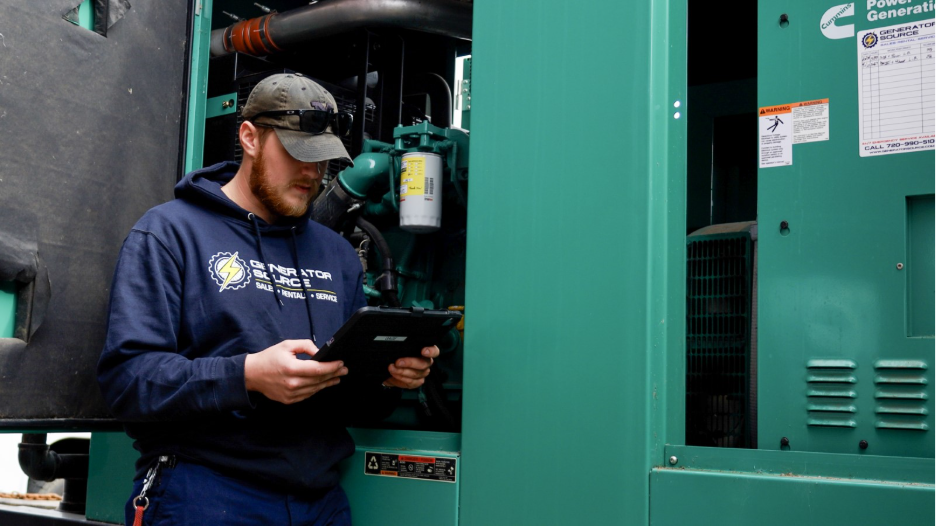
Compliance is documented work. Every test and inspection is logged for the facility’s records.
What Block Load Testing Reveals
Running a block load on a generator produces data the stepped ramp does not: voltage sag depth and recovery time, frequency deviation under a sudden load hit, governor response speed, and whether the fuel system can sustain injection pressure under immediate high demand. According to Generator Source technician Cole, the most common reasons a unit fails a load test, overheating, radiator and thermostat problems, engine leaks, and unstable voltage from a failing regulator, are issues that only show up once the unit is running under real strain. On a used unit, a block load test can expose those faults when the demand spike is sudden. On a new unit, it validates that the generator leaves our yard performing exactly as the nameplate says it should.
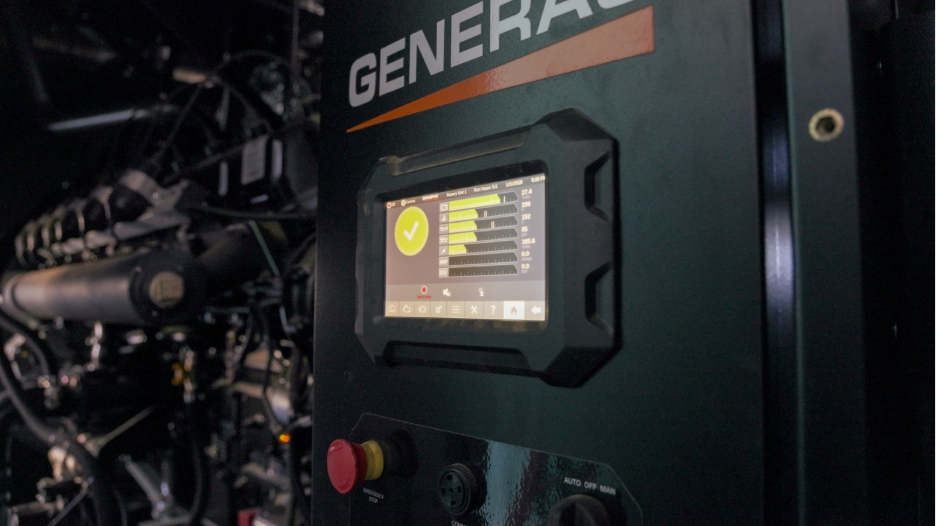
Technicians log voltage, frequency, amperage, and engine data on every leg throughout the test.
Service Director Emett Grazier frames the value plainly: when Generator Source runs a unit at 80%, that is the hardest that unit is going to run all year. The point of pushing it that hard in a controlled setting is to find anything that would otherwise surface during an actual outage. It is the same reasoning behind the company’s wider preventative maintenance approach: load the unit, verify it, and handle the problems up front, not after you need it.
Block load testing is not a replacement for the NFPA-required annual and triennial tests. It is an added layer of proof that the stepped test cannot give you on its own. For critical facilities, it belongs in the program alongside the required testing.
Schedule Load Bank or Block Load Testing with Generator Source
Generator Source performs both standard load bank testing and block load testing for commercial and industrial generators across Colorado, Florida, and Texas. Our EGSA-certified technicians conduct the test, provide full documentation, and identify any issues under load before they show up during an actual outage.
Call 877-866-6895 if your facility needs load bank testing, a compliance review of your current testing program, or a block load test on a unit you are commissioning or acquiring.