
Tesla’s Harris Ranch Supercharger in Central California — the largest EV charging station in the world, with 98 stalls — has drawn attention for a surprising reason: a diesel generator. The claim has bounced around the internet for years, framed by critics as a “dirty secret” that undercuts Tesla’s clean-energy image. But the real story is more complicated than the headlines suggest, and it’s worth separating what’s documented from what’s assumed.
Where the story comes from
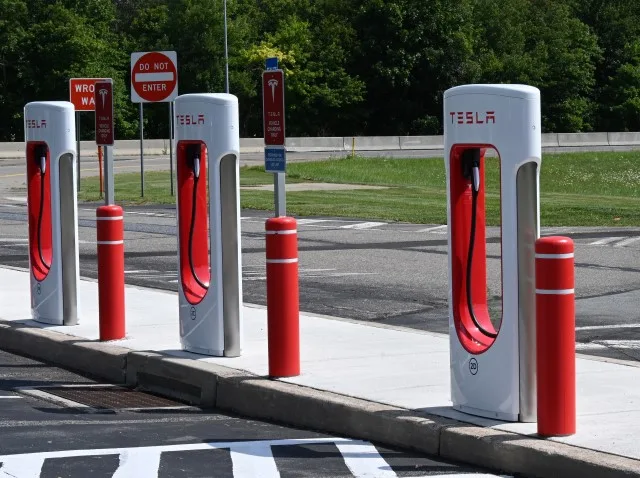
The diesel allegation isn’t a recent discovery. It traces back to May 2015, when investigative journalist Edward Niedermeyer drove to Harris Ranch over Memorial Day weekend and filmed what appeared to be a trailer-mounted diesel generator being used to power additional charging bays during the holiday rush. The footage resurfaced and went viral again in 2023, which is when most of the “Tesla’s dirty secret” coverage was written.
A few things are clear from that footage: the device looked like a portable, towable unit — the kind you’d bring in temporarily for a demand spike — not a permanent power plant wired into the station.
What Harris Ranch says
This is the part most of the viral coverage leaves out. Harris Ranch Resort, which owns the property, has publicly and categorically denied that any diesel plant or generator exists on its grounds. The resort says a building some reports pointed to was never a diesel facility — it started as a car wash, briefly became a Tesla battery-swap station in 2015, and is now a storage building and office for the Harris Ranch Express BBQ team. The resort has gone as far as inviting customers and skeptics to come inspect the property in person.
Just as important: Tesla leases the land from Harris Ranch. The resort neither owns nor operates the Supercharger station, so the two parties have very different vantage points on what equipment was or is present, and when.
So what’s the honest answer?
There’s documented evidence of a portable generator being used at the site during a single high-demand weekend in 2015. There is no confirmation of an ongoing, permanent diesel installation, and the property owner denies one exists today. Tesla has never publicly detailed how its Harris Ranch power is sourced, and even the apps that track Supercharger energy mixes can’t isolate the contribution of any generator. In short: a real 2015 incident has been stretched into a sweeping claim that the current evidence doesn’t fully support.
Why it wouldn’t be scandalous even if it were true
Here’s the context that gets lost in the outrage cycle. Whether the station pulls from a generator or the grid, the underlying power isn’t “clean” in either case — because the grid itself isn’t.
In 2024, U.S. utility-scale electricity generation broke down roughly like this:
- Natural gas: ~43%
- Nuclear: ~18%
- Coal: ~15%
- Wind: ~10%
- Hydropower: ~6%
- Solar: ~5% (including small-scale rooftop)
- Petroleum: under 1%
Renewables together supplied about a quarter of the nation’s electricity. So any EV charging in California is already drawing from a mixed grid, with natural gas as the single largest source. A temporary diesel generator covering a holiday surge is a rounding error against that backdrop — and it doesn’t erase the lifecycle advantage EVs hold over gas-powered vehicles, which depends far more on the overall grid mix than on one charging stop.
The part that’s genuinely worth talking about
Strip away the Tesla angle and there’s a legitimate infrastructure point here. Standby and supplemental power is standard practice across critical operations — hospitals, data centers, telecom, water treatment — anywhere an outage is unacceptable or demand can outrun the local grid connection. Charging stations in remote corridors face exactly that challenge: a site off Interstate 5 may simply not have enough grid capacity wired in to serve 98 stalls at peak.
That’s not a scandal. It’s the reality of scaling infrastructure faster than the grid can keep up, and backup generation is one of the proven tools for bridging the gap. If anything, the Harris Ranch story is a useful reminder of how much reliable, on-demand power still matters — even at the flagship sites of an all-electric future.
Quick answers
- What is the Harris Ranch Supercharger? Tesla’s largest charging station, along Interstate 5 in Coalinga, CA, with 98 stalls.
- What sparked the controversy? A 2015 video appearing to show a portable diesel generator powering extra bays during a holiday rush, which went viral again in 2023 as Tesla’s “dirty secret.”
- Does it actually run on a diesel generator? There’s documented evidence of a temporary generator during one high-demand weekend in 2015. An ongoing, permanent diesel installation has never been confirmed, and the property owner denies any generator exists on site.
- Who owns the station? Tesla leases the land from Harris Ranch and operates the chargers; Harris Ranch does not own or run the station.
- Where does the power come from? Primarily California’s grid, which — like the U.S. grid overall — is a mix of natural gas, nuclear, coal, wind, hydro, and solar.
- Is supplemental/backup diesel power unusual? No. Hospitals, data centers, and other critical infrastructure routinely use standby generators for outages and demand spikes.
- Does this negate the benefits of EVs? No. EV lifecycle advantages depend mostly on the broader grid mix, and a one-off generator at a single site doesn’t change that math.
- What’s the real takeaway? It’s a case study in scaling charging infrastructure faster than the grid can support it — and why reliable supplemental power still matters.