
5x
Median cost difference between a repair caught during PM vs. the same repair as an emergency call
71%
Of emergency break-fix customers had no PM agreement in place
44%
Of no-PM customers already spend more than a PM2 program costs — with nothing to show for it
The five systems that fail, and how often
Across 1,204 field-service quotes, the failures fall into five systems. Ranked by how often they appear:
- Starting system (batteries, charger, block heater, starter): 28.7% of break-fix quotes
- Cooling system (radiator, hoses, water pump, coolant, fan): 26.9%
- Fuel system (tank, lines, filters, separator, pump): 18.8%
- Electrical and controls (alternator, breakers, sensors, wiring): 17.9%*
- Engine and lubrication (oil, turbo, gaskets, exhaust, internals): 12.0%
*The electrical figure includes planned controls and transfer-switch upgrade work, not just failures, so it reflects activity rather than a true failure rate.
Battery replacements alone show up in nearly one in four break-fix quotes (23.8%), which makes them the single most common component we replace, in both emergency and scheduled work. This is where the “it won’t start” call usually comes from.
Two failures set the ceiling on what waiting can cost. The cooling system carries the highest single-event bill in the data, a $39,700 radiator job. The most dramatic case of all is a $46,800 fuel pipe replacement, a problem that started small and went unaddressed until the repair required excavation.
Where these numbers come from: This article draws on Generator Source service data: 1,916 closed-won quotes across 908 generators and 586 customers. Every cost figure is a median from real service tickets unless noted otherwise. These are our numbers, not industry averages.
Preventive maintenance does gets skipped for… reasons: the unit started last time, the budget is tight, and nothing has broken yet. That logic holds right up until it doesn’t.
The data below comes from 1,916 closed-won service quotes across 908 generators and 586 customers. All cost figures are medians from real tickets, not industry averages. Here is what the timing of a repair is actually worth.
What “skipping PM” actually looks like
Of the 458 customers who called us for unplanned, break-fix service, 325 had no preventive maintenance agreement in place. That works out to 71% of the break-fix base.
The lower break-fix rate among PM customers is not a coincidence — it is the point. Scheduled maintenance catches degraded batteries, marginal cooling components, and fuel system issues before they become emergency calls. No program eliminates repair risk entirely; generators are mechanical equipment and parts wear out on their own schedule. But having a technician on site regularly also means small problems get flagged before they compound into the kind of repair that runs five figures.
Same repair, two very different bills
The most useful comparison in the data sets two versions of the same repair side by side. We isolated the repair portion of PM quotes (the parts and labor added when a technician finds a problem during a scheduled visit) and compared it against equivalent break-fix repair tickets. Same kind of work, different timing.
| Quotes | Median cost | Mean cost | |
|---|---|---|---|
| Repair caught during PM | 158 | $350 | $1,012 |
| Break-fix repair | 1,178 | $1,731 | $3,502 |
That comes to roughly a 5x difference.When a technician catches a failing battery during a scheduled PM, the median bill is $350. When the same battery dies during an outage, the median jumps to $1,731. It’s the same component. The difference is the emergency truck roll, the cold-unit diagnostic, the after-hours premium, and the damage done by running a failing system until it quits under load.
Caught early, the median repair by system stays small:
- Batteries and charging: $545
- Block heater: $531
- Cooling: $164
- Fuel: $150
- Engine: $79
The annual math on skipping
A PM2 program (one annual preventive-maintenance visit plus one load-bank test) is typically quoted around $4,400. The underlying data puts the baseline at a $3,680 median and a $5,030 mean, so $4,400 sits between the two.
The catch is that 44% of customers without a PM agreement already spend more than $4,400 a year on reactive repairs. They are paying the prevention money without getting any prevention for it.
The yearly average is not the real concern, though. The bigger exposure sits in the tail: the rare event that runs well into five figures.
| In one service period | PM customers | No-PM customers |
|---|---|---|
| Spent over $5,000 | 9.5% | 31.6% |
| Spent over $10,000 | 4.2% | 15.3% |
| Spent over $25,000 | 2.1% | 4.3% |
| Spent over $40,000 | 0.0% | 3.3% |
One in seven no-PM single-unit customers paid $10,000 or more in a single service period. None of the PM customers crossed $40,000.
The point here is straightforward. Preventive maintenance does not promise a lower average annual bill. What it does is take you out of the catastrophic-event group, the customers absorbing a $25,000 or $40,000 hit. Removing that tail risk is where the real value sits.
Three scenarios every facility manager should know
Scenario A: the small catch
A technician spots a degraded battery during a scheduled PM. The repair added to that visit runs a median of $545. The same battery dies on a Sunday night during a storm, and the median break-fix battery call comes to $1,731, before you count whatever the outage itself cost the building.
Scenario B: the cooling failure
A worn hose or a marginal radiator gets flagged during a PM inspection. The median caught-early cooling repair is $164. The same kind of failure out in the field can run to $39,700, which is a real, documented ticket from our service history.
Scenario C: the fuel system
The most dramatic case on record is a $46,800 fuel-line replacement. It began as a fuel-system integrity problem that went unaddressed until the only remaining fix was excavation. Caught on a PM visit, fuel-system repairs run a median of $150.
What PM covers, and what it doesn’t
The roughly $4,400 PM2 baseline buys a defined scope: an oil and filter change, fuel filter, coolant filter, a visual and multi-point inspection, a breaker-integrity test, a two-hour load-bank test, oil and coolant sampling, plus travel and mileage.
What it does not buy is the repairs found during that visit. Those are quoted separately, which is exactly how the comparison above was built. A PM is not a fix-everything contract. It is a scheduled chance to find a problem while it still costs $350, instead of meeting it under load for $1,731, or for $39,700.
All cost figures in this article are medians and averages drawn across the full range of generator capacities we service, from 20kW units up to 2MW. Larger units carry larger parts and labor, so the numbers skew higher than what a smaller generator would typically see. Your actual service cost depends on the size, make, and condition of your specific unit. For a figure that reflects your equipment, request a quote.
Generator Source Maintenance Plans
Each plan includes everthing in the plan before it
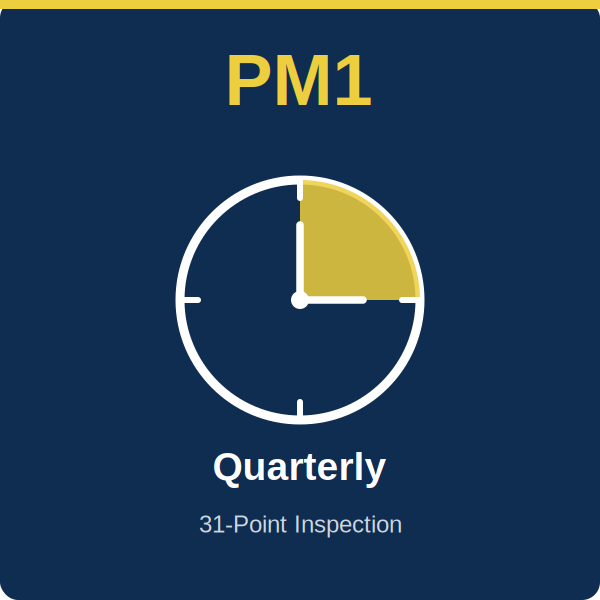
This 31-point inspection examines all critical components to identify potential issues before they become costly problems.
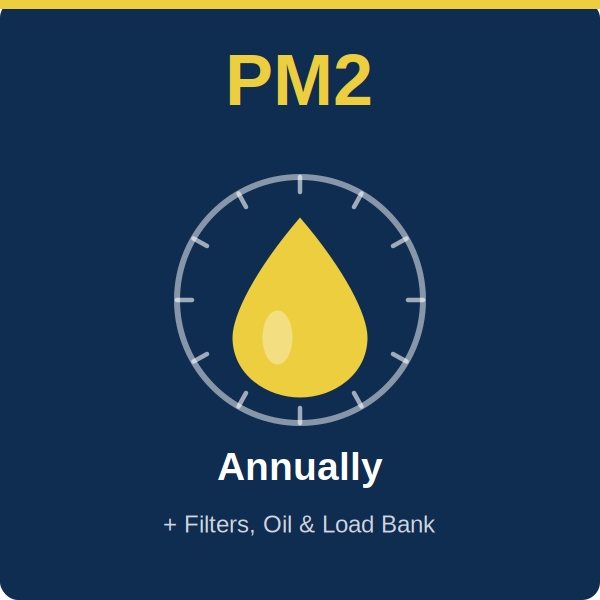
The PM2 includes everything in our quarterly PM1 inspection, plus an oil change, air & coolant filters, and a load bank test.
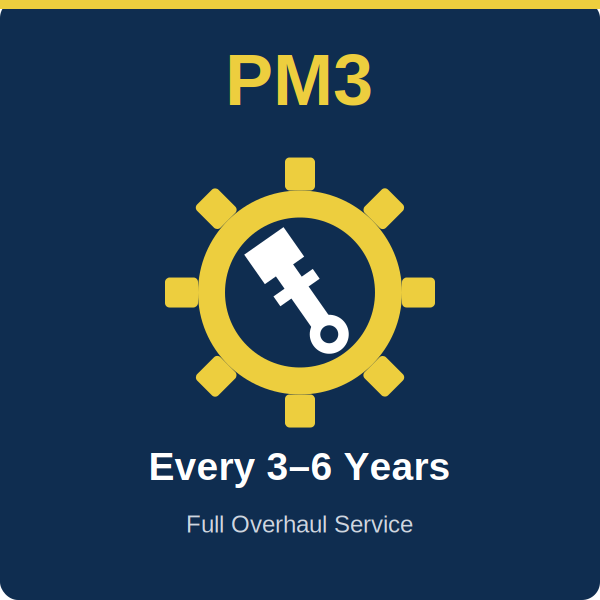
This Preventative Maintenance 3 includes all PM1 & PM2 items plus replacement of coolant, hoses, gaskets, and thermostats.
Still have questions or looking for more information?
Generator Source specializes in low-hour, used, new, and surplus generator sets. We have a wide variety of generator sizes and models to fit any project. We are not a broker, we own what we sell.
Call us today (877-866-6895) or click Contact Us to be connected with one of our experienced sales reps.
We have 350+ generators in stock and ready to ship!