
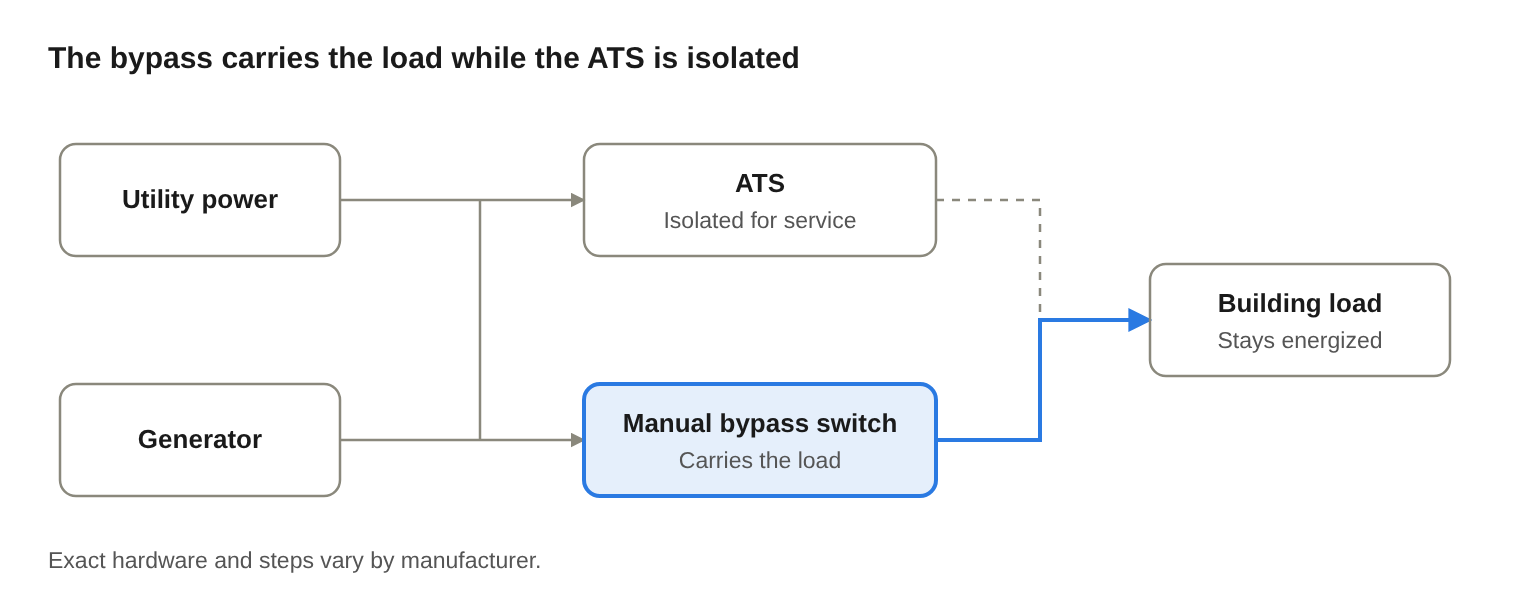
A bypass isolation transfer switch is an automatic transfer switch (ATS) built together with a manual bypass switch and an isolation mechanism. The bypass carries your building’s load while the ATS is disconnected, so a technician can test or repair the switch without a planned outage.
A standard ATS gives your building one path from the power source to the load. Any work inside that switch takes that path out of service, and for a hospital or a data center that is a serious ask. A bypass isolation switch adds a second path so the work can happen with the load still energized.
How does a bypass isolation transfer switch work?
Think of it as a detour around a road crew. Traffic keeps moving on the detour while the crew works on the road.
The assembly holds two switches. The ATS does the automatic work of choosing between utility power and the generator. The bypass switch is a second path to the load, and a technician operates it by hand. An isolation mechanism, often a draw-out design that racks the ATS away from its power connections, lets the ATS be worked on safely. Manufacturers including ASCO, Eaton, Cummins and Generac build these assemblies. Exact hardware varies by model, and some designs use breaker-based mechanisms or an automatic bypass.
A typical service sequence looks like this:
- The ATS runs the building normally and feeds the load from utility or generator power.
- A qualified technician closes the bypass to the source that is feeding the load, and the load now rides the bypass.
- The technician isolates the ATS, usually by racking it out, which separates it from the power connections.
- Service happens on the isolated switch. Many designs also include a test position that lets the technician exercise the ATS while the load stays on one source.
- The ATS is reconnected and checked, then the load returns to it.
Every manufacturer publishes its own procedure, and the technician follows it along with lockout tagout. Only qualified technicians should operate this equipment.
With the ATS isolated, the bypass feeds the building from whichever source is available.
What does a bypass isolation switch leave uncovered?
With a manual bypass, the building runs on a single source while the ATS is out. If utility power drops during that window, no automatic transfer happens, and a person has to be at the switch to move the load. Some designs offer an automatic bypass, so confirm what your unit does before anyone schedules the work. We recommend booking ATS service for a quiet weather window and keeping the technician on site until the load is back on the ATS.
A bypass also leaves the transition type alone. An open-transition transfer still breaks one connection before it makes the next, and whether the load sees a brief interruption depends on the control design. Our write-up on open and closed transition from our Jacksonville ATS training covers the difference.
The assembly covers the maintenance window. The bypass path and the enclosure are still shared, so other single points of failure remain in the system.
Which facilities should specify a bypass isolation ATS?
Start with one question: what does a planned shutdown of your transfer switch cost you? Hospitals, data centers, water treatment plants and cold storage facilities tend to have the most to lose, since a planned shutdown can put patients at risk or spoil a freezer full of food.
Sites that follow NFPA 110 have a second reason. The standard calls for transfer switches to be inspected and tested on a maintenance schedule, and operated monthly. The inspection covers connections, signs of overheating, excessive contact erosion and dust buildup, with contacts replaced when required (Minnesota State Fire Marshal’s NFPA 110 summary). Corrosion and mechanical wear can slow a transfer or stop it, as our ATS maintenance guide explains, and Type 10 systems have 10 seconds to pick up the load. A bypass isolation switch gives a technician room to correct those findings while the load stays energized.
A smaller site that can schedule a short shutdown on a weekend may do fine with a standard ATS. It costs less because it has one switch and no isolation hardware. Your electrical engineer and the authority having jurisdiction have the final say on what your facility requires.
Bypass isolation ATS vs standard ATS
The two differ mainly in what happens when the switch itself needs work.
| Standard ATS | Bypass isolation ATS | |
|---|---|---|
| Servicing the ATS | Needs a planned shutdown or a temporary source path | ATS is isolated while the bypass carries the load |
| Load during ATS service | Dropped, or fed by temporary equipment | Powered through the bypass |
| Automatic transfer during service | None, because the ATS is out | Depends on the design; a manual bypass needs a person at the switch |
| Up-front cost and space | Lower | Higher, since it adds a second switch and isolation hardware |
| Best fit | Sites that can schedule a short shutdown | Sites that cannot go dark for maintenance |
Where does preventative maintenance fit?
A bypass makes ATS service easier to schedule. It does not replace the service. We would rather find a worn contact or an incorrect time delay setting during a planned visit than in the middle of an outage.
Preventative maintenance visits run from annual to quarterly depending on the site, and ATS inspection belongs in each one. Our preventative maintenance program and 31-point inspection are built around finding problems early, and our Jacksonville technicians recently trained on ATS startup and transition types.
If your switch has no bypass, plan the service as a scheduled shutdown with a temporary source. A rental generator can supply the load during that work.
Bypass isolation transfer switch FAQ
What is a bypass isolation transfer switch? A bypass isolation transfer switch is an automatic transfer switch combined with a manual bypass switch and an isolation mechanism. It lets a technician disconnect the ATS for testing or repair while the bypass keeps the load powered.
What are the benefits of a bypass isolation transfer switch? The main benefit is service without a planned outage. A technician can isolate and work on the ATS while the building stays energized, which matters most at sites such as hospitals and data centers that cannot schedule a shutdown.
Does a bypass isolation switch keep the power on during a utility outage? It keeps the load powered while the ATS is out of service. Whether the building moves to generator power on its own during that time depends on the design. A manual bypass needs a person at the switch, and some designs include an automatic bypass.
Does a bypass isolation switch make transfers seamless? No. The bypass preserves a load path for maintenance. Whether a transfer interrupts the load depends on the transition type and the control design.
Is a bypass isolation transfer switch required by code? Requirements vary by facility type and jurisdiction. Your electrical engineer and the authority having jurisdiction decide what applies to your site. NFPA 110 calls for transfer switches to be inspected and tested on a schedule and operated monthly, and whichever switch you choose has to support that.
How often should an ATS be serviced? NFPA 110 calls for monthly operation of transfer switches. Inspection and maintenance belong in your preventative maintenance visits, which run from annual to quarterly depending on the site.
How is a transfer switch without a bypass serviced? The work is planned as a shutdown of that circuit, usually with a temporary source such as a rental generator feeding the load. That adds coordination, and the timing has to fit around the site’s operations.
Does Generator Source service transfer switches? Yes. Our certified technicians service ATS equipment from our branches in Brighton, Colorado; Jacksonville and Pensacola, Florida; and Austin, Texas.
Ask a technician about your transfer switch
If you run a critical facility and you are not sure your ATS can be serviced without an outage, we can look at your setup. Call 877-866-6895 or contact your nearest branch. Have the make and model of your transfer switch handy, along with what it serves, and we will connect you with the right technician.